

Tiger
Artist/Culture
Japanese
DateEDO PERIOD
MediumInk on silk, hanging scroll
Dimensionsimage: 37.9 x 52.1 cm. (14 15/16 x 20 1/2 in.)
overall: 125.9 x 62.7 cm. (49 9/16 x 24 11/16 in.)
overall: 125.9 x 62.7 cm. (49 9/16 x 24 11/16 in.)
ClassificationsPaintings
Credit LineGift of Miss Florance Waterbury
Terms
Object number1957.166
Label TextWorks by the famous Chinese Chan (Zen) monk-painter Mu Xi (died between 1269-1274) were brought back to Japan when Japanese Zen monks traveled to China in the Song and Yuan periods to study with great masters of their sects.Japanese Zen monks came to consider tiger and dragon paintings appropriate side pictures for representations of the Bodhisattva Kannon (Sanskrit: Avalokitesvara). The tiger and dragon are complementary opposites in Chinese cosmology and symbolize the heavenly and earthly principles at work in the universe. Mu xi was the first painter to be called “skilled in painting dragons and tigers” and many copies of his works by both Chinese and Japanese artists existed in Japan by 1500.
This painting is a copy of a hanging scroll painting of a tiger (paired with one of a dragon) by Mu Xi, preserved at the famous Zen monastery Daitoku-ji in Kyoto. The original painting carries the inscription: “the tiger roars and the wind blows impetuously.” Although the inscription does not appear on this copy, the windblown bamboo conveys its meaning.
The horizontal composition is a departure from the original painting on which it is based. Only in seventeenth century Edo period Japan did horizontal compositions become fashionable for the side pictures of a painting triptych.
ProvenanceFlorence Waterbury, New York, NY
On View
Not on view
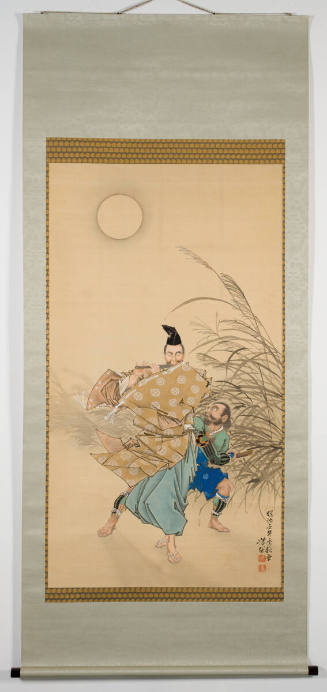
Tsukioka Yoshitoshi 月岡 芳年
late autumn, 1882