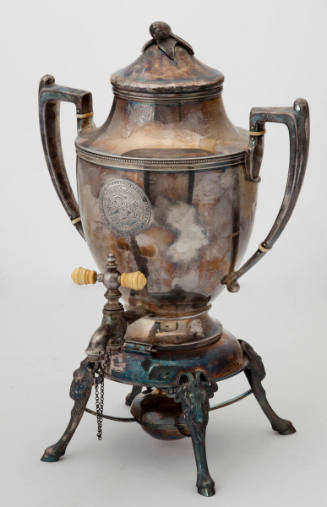


Sugar Urn
Artist/Culture
Joseph Richardson, Jr.
American, 1752–1831
Artist/Culture
Nathaniel Richardson
American, 1754–1827
Date1785–1790
Mediumsilver
Dimensions20 x 4.4 cm (7 7/8 x 1 11/16 in.)
ClassificationsMetalwork
Markingsstamped twice: "INR" on base; engraved on body and lid with garland of flowers and mongram "MW" on medallion on two sides of the body.
Credit LineEliza S. Paine Fund
Object number2002.25
Label TextFrom the colonial era through 1900, Americans avidly acquired silver items to display their wealth. This precious metal had profound social and ecological repercussions across the Atlantic world. The majority of silver used throughout this period originated in Spanish-controlled mines in Latin America. Potosi in present-day Bolivia was the major source through the mid-1700s, when its mines were exhausted and Mexico became a leading supplier. Mining relied on forced labor, subjecting both Indigenous and African populations to horrific working conditions. It also depleted natural resources and devastated the local environment with pollution. One 1759 writer described the cloud hanging over Potosi as:"...vapors and poisonous fumes...from dead animals, from trash heaps, and other fine dust from the ore and from the mercury smoke in the burning and reburning of the [silver]."ProvenanceMade for Mary Wells (1764-1819), possibly on the occasion of her marriage in 1785 to Benjamin Wistar Morris (1762-1825); Samuel Wells Morris (1786-1847) and Anna Ellis Morris (1791-1858); Joseph Paschall Morris (1800-1882) and Sarah Ellis Morris (1815-1898); Charles F. Swan (born 1810) and Catherine Morris Swan (1840-1886); Charles Joseph Swan (born 1864) and Elizabeth Washburn Swan; John Bollinger Thompson (born 1890) and Nina T. Cameron Thompson (born 1896); Colin MacLennan Campbell (born 1921) and Jacqueline T. Thompson Campbell (born 1922)
On View
On viewCurrent Location
- Exhibition Location Gallery 3003