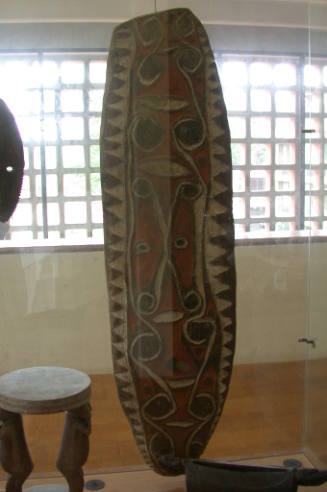

Shield
Datelate 1800s-early 1900s
Mediummolded and tooled hippopotamus hide
Dimensions17 × 57 cm (6 11/16 × 22 7/16 in.), 4 lb, 12 oz (weight)
ClassificationsArms and Armor
Credit LineThe John Woodman Higgins Armory Collection
Object number2014.92
Label TextMost shields throughout history were made of organic materials like wood, leather, or plant fiber. This made the shield light enough to be moved around the body to deflect an incoming weapon. Heavy metal shields wear out the user’s arm very quickly, and had to be held braced close to the torso. The choice of organic materials varies widely from region to region, depending on what is locally available. This example from eastern Africa is made from the hide of a particularly thick-skinned animal, likely a hippopotamus.ProvenanceAngelo Peyron (Florence, Italy) collection, purchased by Museum on November 4, 1954 from Savoy Art & Auction Galleries (NYC), sale no. 450, lot no, included HAM#s 3079.1 & 2.
Collection transfer from Higgins Armory, January 2014.
On View
On viewCurrent Location
- Exhibition Location Gallery 2202