

Stechhelm (jousting helmet)
Culture
Southern German
, Nuremberg
Datelate 1400s
MediumSteel, iron and brass
Dimensions46 × 31 × 40 cm (18 1/8 × 12 3/16 × 15 3/4 in.), 18 lb 8 oz (weight)
ClassificationsArms and Armor
MarkingsOn the outer face of the frontplate, below the central bolt hole is a single "A." All three plates have a single plain chevron within. On the edges, all three plates have an assembly- or serial mark of three nicks.
Credit LineThe John Woodman Higgins Armory Collection
Object number2014.1164.1
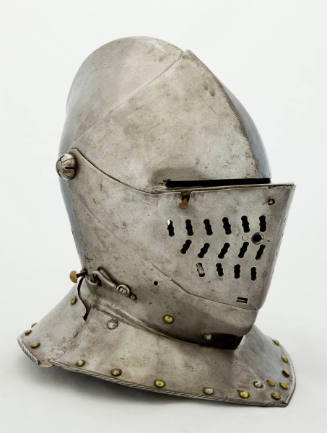
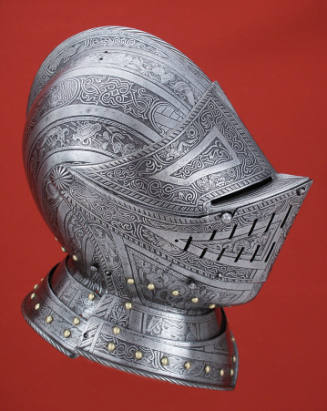
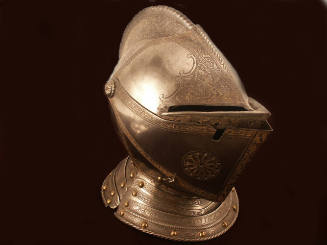
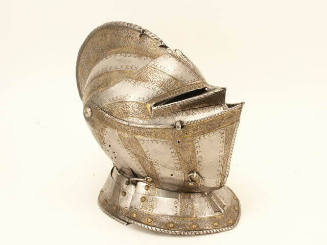
DescriptionThis is formed from three heavy steel plates: a skull plate, front- and backplate—all secured to each other with iron domed rivets with soldered brass caps (apparently original). The skull-plate draws up into a low, broad medial keel which is fitted at mid-length with a reinforcing interior plate supporting a threaded brass insert to receive a crest. Forward of this and at either side of the skull-plate is a longitudinal set of holes for the arming-cap laces. These holes lack the brass rosette inserts once fitted. The skull-plate is roundedly drawn up from its beveled and cusped rear edge, and gracefully tapers forward. The keel becomes a sharp medial ridge, extending to the anterior edge which is the upper limit of the long, deep, “V”-shaped sight.
The upper edge of the frontplate is boxed at the sight with a deep inward turn. Its side faces are deeply concave, with a sharp medial ridge that extends from the sight to gradually fade out on the basal half. This is pierced along the edge with three large, plain holes (one considerably larger), serving to attach to the breastplate, and a fourth, smaller hole above and to the left, formerly for supporting the Stechtartsche. The base edge is unturned, but slightly beveled, dipping to a truncated mid-cusp. The side basal edges of front and rear plates are cut straight across the shoulder and are notched at mid-length for the flange of the breastplate shoulder-straps and below which are two pair of arming point holes without inserts.
On its upper half the rearplate is embossed with a well-formed, radiating pattern of shallow flutes, vertically divided by the posterior terminal of the keel and medial ridge. The latter terminates at the shoulders. To either side of the ridge is an incised and punched hearts-and-diamonds motif in a roseate pattern. Encircling the rear of the helm at the base of the ridge is a row of brass-capped rivets with iron washers for securing a lining-leather, within three incised lines. The lines once extended onto the front plate, but are now worn away there. Just below, and to the left of center is an empty hole which once secured the buckle for the Stechtartsche strap. The rearplate dips off steeply below the point, and is finished with a beveled, cusped edge.
At mid-length along this edge is fitted a hinged, adjustable turnbuckle in an octagonal-sectioned slide, serving to adjust the angle of the sight (cf. Duarte, Horsemanship, p. 109). The base of this is cut in a floral design, and opposed with an “L”-shaped lug which engages a slot on the backplate. The rivets attaching the turnbuckle are restored, but the turnbuckle itself looks to be genuine. The turnbuckle is constructed of three main units: the rearplate/cap-plate unit, the hexagonal outer barrel unit, and the rotating cylindrical inner barrel unit. A hole in the cap-plate has an inserted cylinder, which may be the axle on which the inner barrel turns, perhaps also serving as an insertion point for lubricant. The seat for the inner barrel sits in the lower extension of the outer barrel unit, apparently secured in plate by a rivet shaft extending from the rearplate hook, to judged by a peened circle in the middle of the seat.
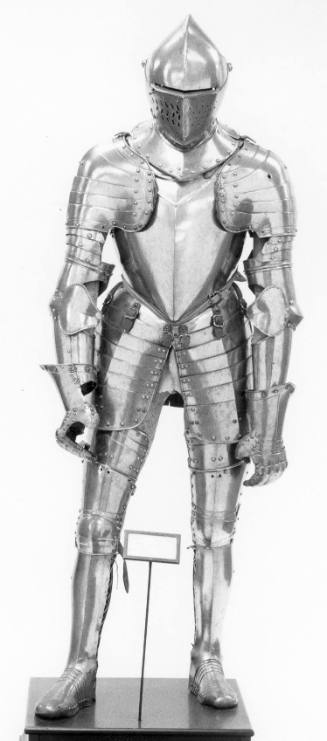
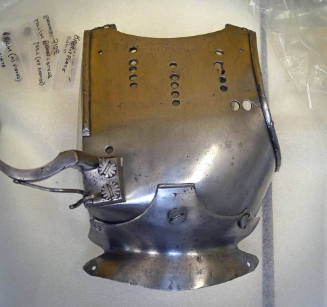
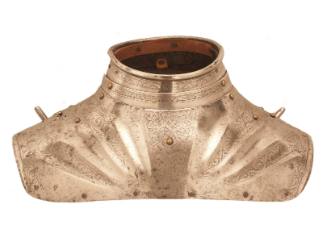
The frontplate is secured to the breastplate by three floral-headed bolts, slotted for a spanner (two of the bolts match), passing though the top of holes noted above.
In addition to multiple lance marks across the frontplate, and a couple on the upper plate, the apex of the upper plate has some blunt deformations, suggesting impact on the top of the helmet.ProvenanceCounts Erbach-Erbach (Erbach in Odenwald)
E. Kahlert und Sohn (Berlin)
Clarence H. Mackay (Roslyn, L.I)
Purchased by the Armory from Jacques Seligmann & Co., Inc. (NYC), agents for the Mackay estate, on 1 April 1940, as #A-43/120.
Collection transfer from Higgins Armory, January 2014.
On View
On viewCurrent Location
- Exhibition Location Gallery 0010

Set/Part of a Set
