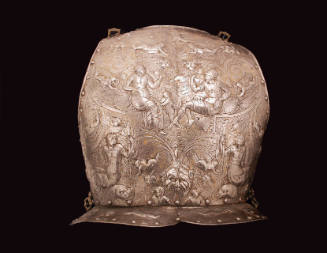

Mirror
Artist/Culture
Etruscan
Date3rd century BCE
Mediumbronze
Dimensions26.4 x 13.2 cm (10 3/8 x 5 3/16 in.)
ClassificationsMetalwork
Credit LineMuseum Purchase
Object number1949.11
DescriptionThe engraved design on the back represents the two Dioskouri (Castor and Pollux) who are seated facing each other; a standing nude youth (one of the Cabeiri ?) and a standing female figure (Helen?). Behind the heads of the figures the architrave of a building is indicated, with a wavy line above. Around the edge is a laurel wreath.Label TextThe back of this mirror, facing you, is decorated with an engraved scene of four divinities engaged in conversation.
The two seated figures may be the Dioscuri, the divine twins who
were sons of Zeus. The two standing figures are probably the gods
Apollo and Minerva. Many Etruscan mirrors bear similar groups in
conversation, but their meaning is not understood. The handle of
the mirror ends in a ram’s head.
How does this work as a mirror?
Originally the front of the mirror, facing away from you, was a sheet
of brightly polished bronze, which would have reflected your image.
It cannot be used as a mirror today because the entire surface is
covered with a greenish-blue corrosion layer.
ProvenanceProf. Ernest T. Dewald, Princeton, NJ
On View
On viewCurrent Location
- Exhibition Location Gallery 0008