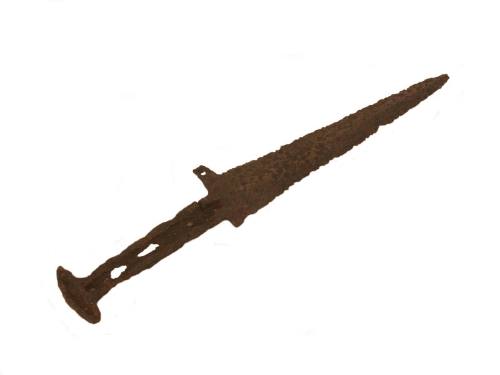
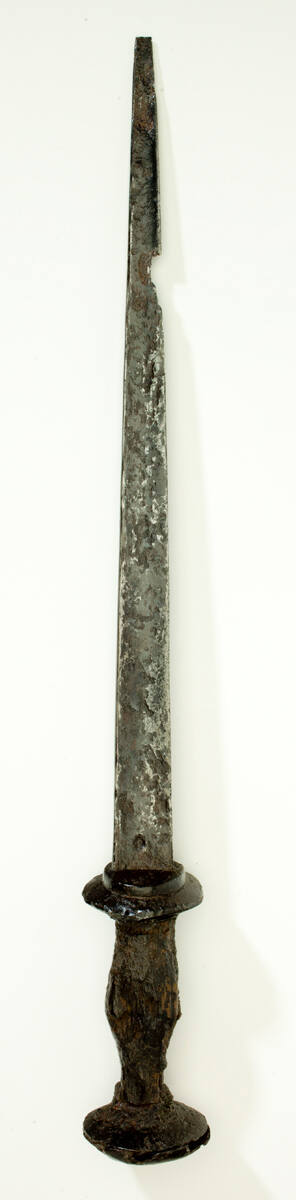
Excavated "Baselard" Dagger
Culture
European
Date1300s–1400s
Mediumsteel and iron
Dimensions31.8 × 20.2 × 4 × 6.2 cm (12 1/2 × 7 15/16 × 1 9/16 × 2 7/16 in.), 6 oz (weight)
ClassificationsArms and Armor
Credit LineThe John Woodman Higgins Armory Collection
Object number2014.452
Description1 piece of iron, "Baselard" form. Acutely pointed blade of stiff, flattened-diamond section, with pronounced medial rib on faces. Base of blade flares into 2 integral trapezoidal projections (one lacking) forming a rudimentary crossguard. Projection punched by single hole. Corroded blade has been ground down.Face of tang cut with full-length, broad channel into which was set wood or horn plaques (missing). 3 vertically aligned, punched mounting holes & traces of a fourth. Upper part of tang flares out into flattened, mushroom-like profiled terminal. This transversely cut for inset plaque of elliptical form, & retains 2 crudely fitted, iron dome-headed rivets. Tang has cracked near the crossbar.ProvenancePurchased by John W. Higgins from Sumner Healey, New York City on March 20, 1931.
Collection transfer from Higgins Armory, January 2014.
On View
Not on view
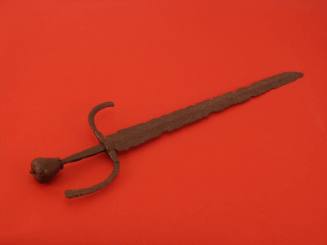
1480–1500