

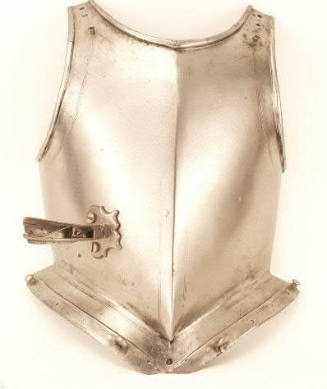
Backplate
Culture
Southern German
Dateabout 1480–1490
MediumSteel and iron
Dimensions52 × 33 × 15 cm (20 1/2 × 13 × 5 7/8 in.), 3 lb 12 oz (weight)
ClassificationsArms and Armor
MarkingsThe capped A appears on the exterior of the mainplate at the left shoulder. Both the mainplate and tailplate are marked on the inside face with the incised chevron. There are 2 punched dots near the reinforced hole at the left shoulder, with 1 dot on the plate adjoining. There are 3 punched dots adjoining the reinforced hole at the right flank.
Credit LineThe John Woodman Higgins Armory Collection
Object number2014.1164.4
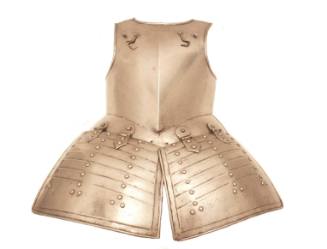
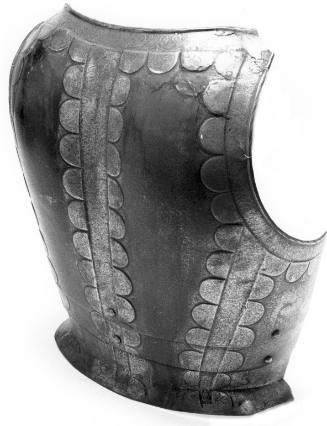
DescriptionThis is probably South German or Austrian, ca. 1480-90. It appears to have been a later modification of a pre-existing field piece in order to be used with a Stechzeug breast. The mainplate is deep, shaped to the shoulders and extending well around the sides, the terminal edges of which are concave and fitted with threaded inserts for the bolts of the side hinged plates. The left terminal has two serial nicks. The neck opening is shallow and unturned. It is decorated with a bordering motif of an incised and punched guilloche design. (This should be compared to similar decoration on other contemporary pieces, such as that on a bevor ascribed to Matthes Deutsch of Landshut, ca. 1480. See p. 68 of the Burg Hornburg exhibition catalogue by Bidermann, 19.) There is a pair of lacing holes at the top center of the plate.
The edges of the armpits are angular, and outwardly turned. They are bordered with three narrow, shallow flutes. The medial region of the backplate is similarly embossed with a pair of five flutes each from the armpit and converging into two each at the basal edge center. Along the medial line the back is cut with a close-set pair of incised lines. This group is pierced at the neck opening with two holes for points, and near the bottom by a vertical pair of oblong slots for the hook of the helm turnbuckle. These are crudely cut relative to the execution of the backplate overall, suggesting a working-life modification.
The basal edge rises to a point of moderate height. It is hollow-flanged, and bordered by a shallow, sunken band pierced for rivets. The flange itself is decorated with spaced groups of three file-marks each.
The shoulder terminals are fitted with threaded reinforces as above, but these have been relocated and rotated 90 degrees. Angularly cut below these on each shoulderblade is a group of three rectangular slots, either group with a buckle tongue. These cuts are for the straps noted under the breastplate [Forgeng 2026: note however that the arrangement of the slots suggests that the strap was meant to lie on the outside of the plate, not the inside, which may suggest that these fittings were for a prior attachment of the front to backplates]. The slots are crudely-cut and poorly located, and they interfere with the fluting, suggesting another working-life modification.
A tail-plate (Schwanzel) from a Rennzeug is secured with four rivets to the medial base edge of the mainplate. It is poorly aligned with the mainplate, and appears to be a working-life association. This is roughly of hourglass outline, narrowing at the waistline and of trapezoidal form below. The upper edge of the plate is pierced with a row of lining-holes and the lower half bordered with flush lining rivets.
The basal edge is finished in a roughly-boxed, outward turn, and has three serial nicks. Just above the basal edge are two empty holes, probably for rivets. The padding and side leather strips for laces are lost.ProvenanceCounts Erbach-Erbach (Erbach in Odenwald)
E. Kahlert und Sohn (Berlin)
Clarence H. Mackay (Roslyn, L.I)
Purchased by the Armory from Jacques Seligmann & Co., Inc. (NYC), agents for the Mackay estate, on 1 April 1940, as #A-43/120.
Collection transfer from Higgins Armory, January 2014.
On View
On viewCurrent Location
- Exhibition Location Gallery 0010
Michel Witz the Younger
1530s
Set/Part of a Set
